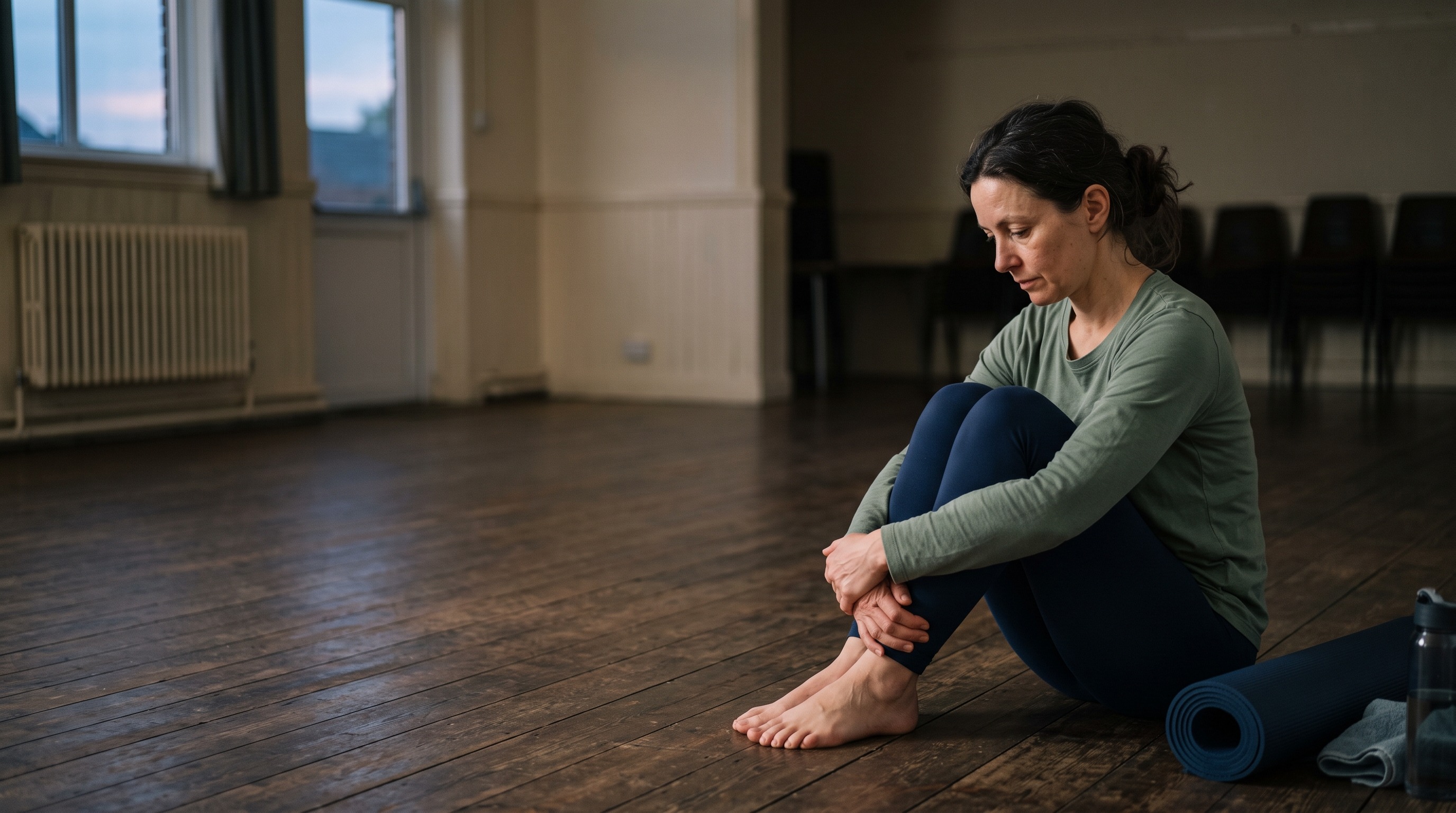
- Replaying a flat class rehearses it rather than resolving it; rumination research shows the loop deepens the groove without adding any new information.
- How big a flat class becomes is set by how you explain it, not by the hour itself (Seligman’s explanatory style: time, reach, cause).
- A short close-down in order helps: move for two minutes, breathe with a long exhale, name it once, write two lines, shut the book.
- Naming the feeling plainly, ’that one didn’t land’, lowers its charge; then stop.
- If a class keeps reopening, that’s a sign to say it to a trusted teacher, not to replay it alone.
- One flat class is one flat class, with causes mostly beyond you. It is not a verdict on your teaching.
After a yoga class that didn’t land, what helps is a short close-down, not replaying the hour on the way home. Move for two minutes, breathe with a long exhale, say out loud that it didn’t land, then write two honest lines and shut the notebook. It’s what YogaPros teaches its members for a flat night.
By YogaPros — the professional body for yoga teachers since 2006, with more than 10,000 members across 100+ countries.
Does every yoga teacher have classes that fall flat?
Yes, on schedule. Nobody teaches for long without the night you knew by the third posture that the room never warmed up, when the sequence you were happy with on paper felt like reading out someone else’s notes. One student rolls their mat up ten minutes early. By the time you reach your street you’ve re-taught the whole hour twice, and the story has quietly grown past the evening.
Fifteen years in or fifteen weeks, the flat class arrives. What varies isn’t whether it happens. It’s how much of the week it’s allowed to take, and that gets decided in the first hour afterwards.
Why does going over the class make it worse?
Because replaying rehearses the class instead of digesting it. Research on rumination is clear on this: looping back over a difficult hour doesn’t process it, it wears the groove deeper and makes the conclusion feel more true, while no new information arrives at any point. The teacher who has re-taught a flat class five times by midnight doesn’t understand it any better than the one who looked at it once. They just feel worse.
And the body is part of it. Rumination likes stillness: the parked car, the lying-awake position. That’s why the close-down below starts with movement instead of thought.
How big is one flat class allowed to be?
As big as one evening, unless you let it spread. In the 1970s the psychologist Martin Seligman began asking why the same setback flattens one person and barely marks another. The difference sat in the explanation rather than the event. What he called explanatory style turns on three readings most of us make without noticing.
Time. Read as ’tonight was flat’, the class stays the size of one evening. Read as ’I’ve lost it’, it spreads across your future. Same sixty minutes.
Reach. One clunky sequence might mean the sequence needs work. In the harsher reading it means the whole career is in question. The evidence didn’t change; the radius did.
Cause. A cold room at half-term, a group that came in tired from work. You were one variable among several that evening, and the hard reading deletes the others and keeps only you.
A flat class is allowed to be what it was: one flat class, with causes, most of them not you.
What should I do in the hour afterwards?
Run a short close-down, in this order. The order matters.
- Move first, two minutes. Walk the long way to the car, or shake your arms out in the empty studio while the kettle boils. The spiral needs a still body, so don’t hand it one straight away.
- Then breathe. Ten rounds with the exhale longer than the inhale, the same slow breathing you’d offer a student who arrived wired. It settles the nervous system measurably, and that doesn’t stop being true when the wired one is you.
- Then name it, once. Out loud if you’re alone: ’that one didn’t land.’ Research on putting feelings into words finds that naming an emotion plainly lowers its charge. Name it and stop. No speech to the windscreen.
- Last, two lines in a notebook. One line of evidence, something that verifiably happened, the good with the bad: ’sequence rushed after the standing series; the student with the stiff shoulder said it finally let go.’ One line of adjustment, the single small change worth making next week. Then the book shuts, and the class is over. Not at 2am. When the book shuts.
If the same class keeps reopening after you’ve closed it, treat that as information rather than failure. It usually wants saying to another teacher, not another lap around your own head. Said out loud to someone you trust, these evenings tend to come back to their real size, which is smaller than midnight makes them.
How do I make the close-down a habit?
Keep a small notebook in your teaching bag, so the two lines have somewhere to land within reach. After your next few classes, move for two minutes before you let yourself review anything, even the good ones, so the pattern is already there when you need it. Then, the next time a class falls flat, run the whole thing in order: move, breathe, name it, two lines, shut the book. If it’s still sitting there in the morning, that’s the moment to test its size for time and reach before the week takes its shape from it.
Steadiness on a flat night is professional practice, and it was never meant to be a private effort. The standards you teach under exist to hold the teacher as well as the class. This month, tell one teacher you trust about a class that didn’t land, and notice what happens to its size once it’s out of your own head and in the room.
Members go deeper. YogaPros members can read the fuller version of this piece in the Learning Hub, with a one-page close-down to keep in a teaching bag for a flat night. It’s part of the Wellbeing & Mindset collection: practical support for the working life of a yoga teacher, not the performance of calm.