- Yoga teaching is care work done mostly alone, which is the exact shape of work that leads to burnout when support is thin.
- The World Health Organization classifies burnout as an occupational phenomenon — a product of the work, answered by changing the work rather than by pushing through.
- Other caring professions build support in as a requirement: counsellors have supervision, nurses have reflective revalidation. Yoga teaching grew fast and informally, so teachers inherited the demands without the scaffolding.
- A practical support structure is smaller than it sounds: one weekly hour of your own practice, and one other teacher you speak to regularly.
- A professional body sits underneath the individual structure — so on the weeks a teacher’s own routine slips, something still holds.
Yoga teachers spend their working lives holding space for other people, and often have nobody holding it for them. Building real support into a teaching career is not a luxury — it belongs in the same category as insurance and training. In practice it comes down to two habits and one thing bigger than any single teacher.
By YogaPros — the professional body for yoga teachers since 2006, with more than 10,000 members across 100+ countries.
Why the question matters
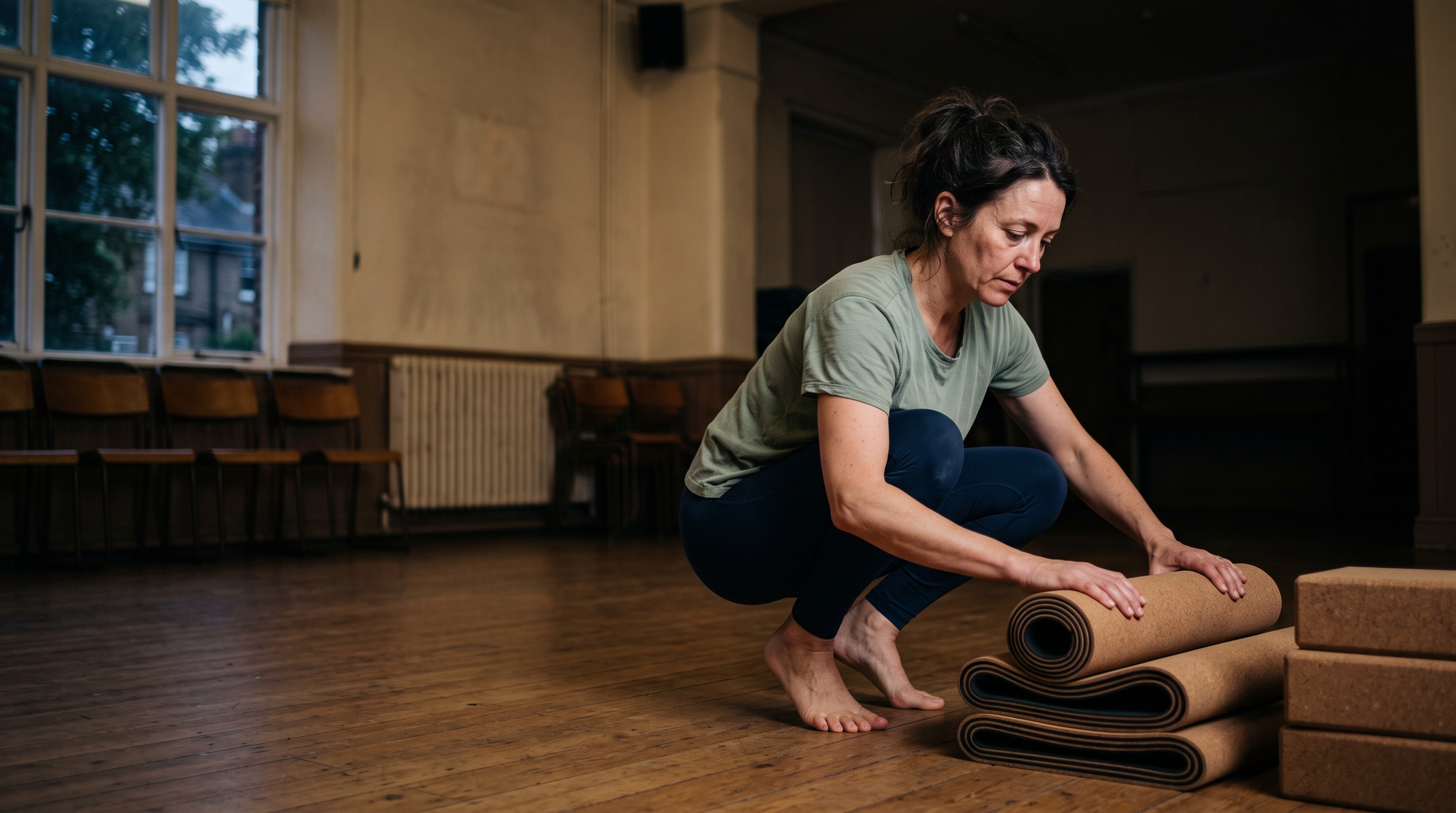
There is a strange arithmetic at the centre of a teaching life. The person holding everyone else’s hour is usually the only one in the building with nobody holding theirs. A teacher finishes a class that left the room lighter, wipes the floor, stacks the blocks, carries the speaker to the car, and drives home on empty.
That drive is common property in the profession, though it rarely feels shared at the time. And it points at a real occupational risk, not a mood.
Why do yoga teachers burn out?
Teaching yoga is care work. The room is calm and the setting is chosen, so it rarely gets named that way, but an hour of holding attention on other people’s bodies and states is an hour of giving out. And unlike most care work, it is built to be done alone. There is no staff room and no handover. The difficult moment in the six o’clock class gets processed in the car, or not at all.
Research on burnout in the helping professions has said the same thing for four decades: sustained care of others, joined with thin recovery and thin support, wears people down in a predictable way. The World Health Organization classifies burnout as an occupational phenomenon in the ICD-11 — the result of chronic workplace stress that has not been successfully managed. Occupational. It comes from the shape of the work, which means it is answered by reshaping the work rather than by gritting through it.
Why self-care for a yoga teacher is professional maintenance, not a luxury
Most teachers file their own care under luxury, somewhere below new props on the list of things to get round to. The professions that last file it under maintenance.
Recovery science is blunt about why. Capacity for sustained work tracks the recovery built around it, and recovery is an activity rather than an absence. Sleep counts, and so does a day off that stays off. A practice of your own, the kind that produces nothing, restores more than it looks like it should.
Nobody calls servicing the car an indulgence, and nobody thinks a studio maintaining its floor is being precious. A teacher’s body and steadiness are the working equipment of the profession. Maintaining the equipment is part of the job, and a teaching career that plans its own upkeep tends to still exist in ten years.
How do other caring professions handle this?
The mature caring professions learned this slowly and then built the answer in.
- Counselling and psychotherapy require ongoing clinical supervision — a regular, structured conversation about the work, treated as a condition of practising, not an optional extra.
- Nursing builds reflective practice into revalidation, so looking honestly at the work is part of staying on the register.
Yoga teaching grew fast and largely informally. Teachers inherited the demands of a caring profession without inheriting its scaffolding. Nobody decided that; it is simply where the profession’s history left things, and it is a gap each working teacher currently has to close deliberately.
What does looking after yourself actually involve?
Less than the word “structure” suggests. Two habits carry most of the weight.
- One weekly hour of your own practice. In the diary like a class. Taught by someone else or by nobody, and never by you. This is the practice that produces nothing and restores the most.
- One other teacher you speak to on a standing basis about the work as it really is — a fortnightly call or coffee, with no agenda beyond honesty. It is the nearest thing the profession has to informal supervision, and teachers who have it describe the job differently.
Underneath those two, a short weekly audit helps: read your own timetable the way you would read a student’s posture, noticing where the load is landing and what needs releasing before it starts to complain. And check the floor under all of it — insurance current, and someone you could call if a class went wrong.
Where does a professional body come in?
Some of the answer is a structure only the individual teacher can build, because nobody else can schedule your rest. And some of it is bigger than any one teacher.
A professional body provides the layer an individual cannot assemble alone: standards that assume a teacher who looks after their own state as well as their students’, insurance and real support behind the work, and a community of peers who know the job from the inside. It does not replace the weekly hour or the standing call. It sits underneath them, so that on the weeks a teacher’s own structure slips, something is still holding.
That is the honest answer to the question in the title. Some of who looks after the teacher is the teacher, deliberately. The rest is the profession she belongs to.
Members go deeper. YogaPros members can read the full version of this piece in the Learning Hub, with a downloadable one-page guide for building a personal support structure over the next month. It is part of the Wellbeing & Mindset collection — practical support for the working life of a yoga teacher, not the performance of calm.