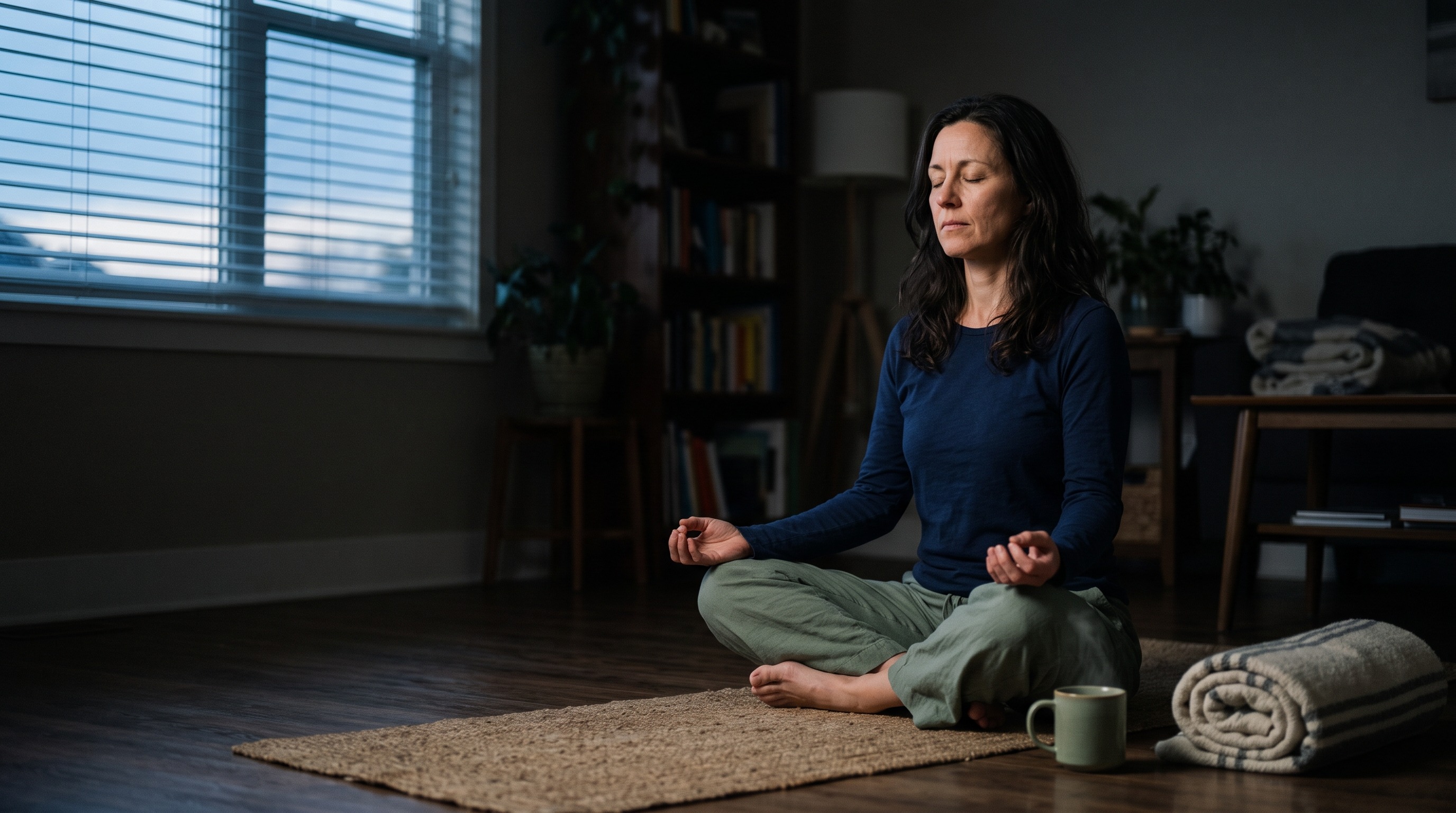
- Somewhere in the first year of teaching, most teachers’ own practice quietly turns into preparation. You get on the mat and start sequencing for a class instead of practising for yourself.
- A practice that only ever happens in public slowly becomes performance. You feel it as dryness first, in cues that come from memory rather than from this morning.
- Yoga already holds the teacher’s own practice as core, not extra. Svadhyaya, self-study, sits among the niyamas, and a short daily discipline has always been called sadhana.
- The morning routine sold on wellbeing shelves is yoga’s own inheritance under newer names: pranayama for the breath before the day, sankalpa for the one-sentence resolve at its centre.
- Ten minutes is enough, and the rules matter more than the sequence. No phone, no audience, and nothing from it has to survive into a class.
- On the mornings it collapses, the floor is three breaths and the sentence. Habit research is clear that the floor keeps a practice alive, not the ceiling.
A yoga teacher keeps a personal practice by protecting a short piece of the morning that is theirs alone, kept separate from anything they teach. Ten minutes is enough. Build it from yoga’s own tradition (sadhana, pranayama, sankalpa) rather than the wellbeing-shelf version, and keep it off the timetable. It’s the practice depth YogaPros treats as the root of real teaching authority.
By YogaPros — the professional body for yoga teachers since 2006, with more than 10,000 members across 100+ countries.
Why do so many yoga teachers lose their own practice?
Because teaching quietly turns practice into preparation, usually inside the first year. You get on the mat and half of you is already sequencing: would this transition work for the Saturday group, would that cue land. One morning it dawns on you that you can’t remember the last time you practised without planning to teach any of it.
Ask around a staff room and most teachers can roughly date it. The day the teaching started, practice changed hands. It didn’t disappear. It just stopped being yours.
Does it matter if the only practice you get is teaching?
Over time, yes. A practice that only ever happens in public slowly becomes a performance, however sincere you are. You feel it as dryness first: cues that used to come from somewhere now come from memory. Students seldom spot it. You always do.
And there’s a professional cost sitting under the private one. Rooms settle differently for a teacher who is still practising for themselves, and most experienced teachers know which kind of room they’d rather sit in. The difference between a cue drawn from this morning and one drawn from 2019 is quiet, and rarely conscious, but it is there.
Where does a personal practice actually come from in yoga?
From the tradition itself, which built the teacher’s own practice in from the start. Svadhyaya, self-study, sits among the niyamas: yoga lists a teacher’s inward work beside the ethics, as discipline rather than decoration. Practice turned toward your own interior was never optional extra credit. It’s where the teaching is supposed to come from.
Which is worth holding in mind next time you pass the wellbeing shelf in a bookshop. The morning routine is everywhere there: breathe before the day starts, set an intention, notice something you’re grateful for, get still before the noise arrives. It’s sold as new science, at volume, with its own merchandise. And it has much older names. A short daily discipline is sadhana. Breath taken deliberately before the day is pranayama. The one-sentence resolve at the centre of it, the thing the apps now call an intention, is sankalpa; the stillness and the gratitude are old too. The wellness industry is selling the profession its own inheritance back to it, and you’re allowed to take yours straight from the shelf it has always sat on.
The modern evidence is real, and worth having. Gratitude research supports a line or two noted now and then: occasional and specific beats daily and vague, because detail keeps the mind actually looking. Slow-breathing studies find the nervous system settling within minutes. Habit research adds the practical part, that a practice anchored to a cue you already have, with a low floor for the bad days, is the one that survives. None of it needs defending to anyone. You spent years learning these tools. Using them on yourself first is how they were always meant to work.
What does a ten-minute practice for yourself look like?
The rules matter more than the sequence. This practice isn’t content, and nobody ever sees it. The phone stays in another room. It does not have to be good. And nothing from it needs to survive into Saturday’s class.
The shape is about ten minutes. Sit before the phone gets to you. Three settling breaths, then a few minutes with the exhale longer than the inhale. If the body asks to move, follow it without sequencing anything; some mornings it only asks to stay still, and that counts. Then the sankalpa: one present-tense sentence, plain words, kept for a whole season rather than rewritten each day. It doesn’t have to mention teaching at all. Teachers often make the sentence about their students out of habit, and this is the one that gets to be about you. Finish with a single line of gratitude, noticed or written down, and let it be specific: a name, a moment, not a category.
If ten minutes sounds impossible in your house, make it six. The point is ownership, and six owned minutes outweigh forty borrowed ones. On the mornings it collapses, and some will, the floor is three breaths and the sentence. Habit research is unsentimental about this: the floor is what keeps a practice alive, so protect the floor before you reach for the ceiling.
Where does a professional body come into a private practice?
It can’t run your practice for you; nobody can schedule your morning. What a professional body can do is recognise where teaching authority actually comes from. The standards YogaPros verifies rest on practice depth, years on the mat counted before years in front of a room. And the part of that depth no record will ever show is exactly this: the practice that is yours alone.
Members go deeper. YogaPros members can read the full version of this piece in the Learning Hub, with a one-page guide to building a ten-minute practice of your own and keeping it through the weeks it wobbles. It’s part of the Wellbeing & Mindset collection: practical support for the working life of a yoga teacher, not the performance of calm.