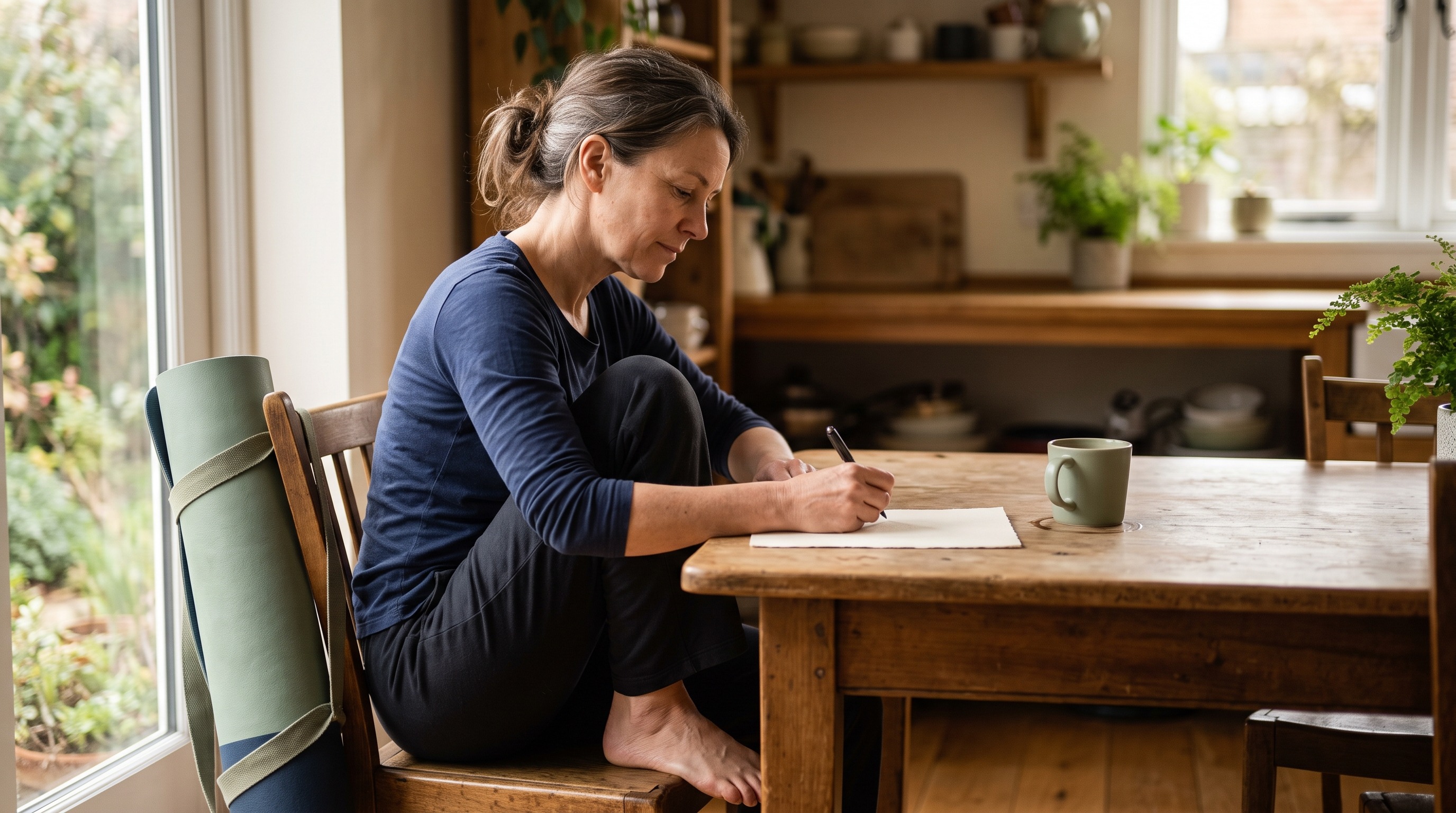
- Almost every profession stops once a year to review the work. Yoga teaching does not, unless you build the review yourself.
- The whole review fits on one page: why you teach, and what this year is for. Written once, kept in view, read far more often than it is rewritten.
- Written, specific intentions get acted on far more reliably than ones held in your head. Decades of goal-setting research point the same way.
- A visible commitment keeps working on you, which is why the page belongs on a wall or in a planning folder and never in a drawer.
- The page has seven short fields: why you teach, what you are building, the question you teach from, your rules for a good class, the signals you will trust, one intention per season, and two review dates.
- Yoga’s older name for this is sankalpa, an intention stated plainly and returned to until it starts to shape the year around it.
Nobody books your annual review when you teach yoga, so you run it yourself, and the whole thing fits on a single page. One sheet in your own handwriting: why you teach, and what this year is for. Written once, kept where you’ll see it, read far more often than it is rewritten. YogaPros’ Live CV holds the half of your year a page cannot.
By YogaPros — the professional body for yoga teachers since 2006, with more than 10,000 members across 100+ countries.
Why should a yoga teacher plan the year at all?
Because almost every other line of work stops once a year to look at itself, and yoga teaching does not unless you build that pause yourself. Somebody books a room, asks what went well and what did not, then writes down where you are heading. It can be tedious. It also does something quietly important: once a year, the work gets looked at instead of only done.
When you teach yoga, nobody books that room. Picture a Sunday evening in September, the new diary open at a blank week, and you copying the timetable across from the old one. The 6pm, then the 7.30. Same grid, same handwriting, one year on. You have planned next week hundreds of times. You may never once have planned the year.
Why does one page work better than a big plan?
Because small and visible beats big and filed away. Goal-setting research going back to the 1960s, led by Edwin Locke and Gary Latham, keeps finding that specific, written intentions get acted on far more reliably than the ones you keep in your head. A hope stays a hope. And a line on paper is a decision you have already made once.
Work on commitment devices adds the second half: a promise you can see keeps working on you, which is why this page belongs on a wall or in a planning folder and never in a drawer. Yoga holds the older version of the same idea. A sankalpa is an intention stated plainly and returned to until it starts to organise what happens around it. This page is a sankalpa with a pen in its hand, written in your own words and read back on purpose.
What goes on the one-page plan?
Seven short fields, each answerable in a line or two.
- Why I teach. One or two sentences, in words you would say out loud. Everything else on the page answers to this line.
- What I am building this year. The classes, the setting, the standing you want twelve months to add. “A settled Tuesday and Thursday, and my first daytime class” is a perfectly good answer.
- The question I teach from. The steadier inner question you have chosen to work under this year.
- My rules for a good class. Two or three conditions that are yours to control, such as your preparation done and your attention genuinely in the room. Rules an empty Tuesday cannot break.
- The signals I will trust. Your own measures of a good year: who keeps coming back, the hours and years stacking up behind you, and now and then a sentence a student said that you wrote down the same evening.
- One intention per season. A teaching year has seasons. January fills and August thins, and each stretch does different work, so give every season one job. A year is easier to hold as four smaller ones.
- Two review dates. In the diary before the pen goes down. Twenty minutes each, six months apart.
How do you write it and keep it?
Give it one evening. Forty minutes, with last year’s diary and any course notes within reach, and a first draft that is rough and truthful. Nobody else needs to see this page, so write like nobody is marking it.
Then put it where your eyes already go: the front of the planning folder, or the inside of the wardrobe door. Photograph it for your phone if you like, but keep the paper original, because paper carries a weight a screen does not. Amend it in pen at the review dates and leave the crossings-out visible. They are the record of an honest year.
Re-read it when a season turns, and on any Tuesday when the work feels like it is just happening to you. The page will not answer everything. It’ll remind you that someone is steering the year, and that it is you.
How does the page fit your professional record?
An annual look at the work is ordinary professional practice nearly everywhere else, and this page holds the half of it only you can see: why you teach, and where you are taking the year. Your Live CV holds the other half, the verifiable record of the same twelve months: the qualifications, the training, the hours, the years behind you. Read side by side, once a year, they are the closest thing this profession has to the review meeting nobody else books for you.
Members go deeper. YogaPros members can read the full version of this piece in the Learning Hub, with a printable fill-in version of the one-page year, sized to live where your planner lives. It is part of the Wellbeing & Mindset collection: practical support for the working life of a yoga teacher, the parts of it nobody else books a room to look at.